


How to Transfer Spotify Playlist to Tidal [2026 Guide]
For many users, music streaming is no longer a single-platform experience. People switch between services, Spotify, Tidal, Apple Music, and YouTube Music, depending on subscription deals, audio quality, or feature preferences. One of the most common challenges that emerges during a platform switch is playlist migration. If you’ve built years of playlists on Spotify but now want to enjoy them in Tidal, the last thing you want is to rebuild them from scratch.
This guide walks you through every working method to transfer a Spotify playlist to Tidal. We cover automatic playlist migration tools and manual methods. Whether you prefer a fully automated cloud transfer or want to keep local offline copies of your Spotify tracks before switching, you’ll find everything you need here.
Contents Guide Can You Transfer Spotify Playlists to Tidal?Method 1: Transfer Spotify Playlists to Tidal Using Soundiiz (Recommended)Method 2: Transfer Spotify Playlists to Tidal on Mobile Using SongShiftBonus: Keep Copies of Your Spotify Playlists ForeverFAQsConclusion
Can You Transfer Spotify Playlists to Tidal?
Spotify and Tidal are both major streaming platforms, but they operate independently. They do not provide native cross-platform playlist export/import features. This leads to three major challenges:
Closed Ecosystems
Spotify playlists exist inside Spotify’s environment. You cannot export them directly as a Tidal-compatible playlist.
DRM and Licensing
Spotify tracks are DRM-protected; Tidal cannot import them as playable files even if you somehow save the playlist metadata. This is why third-party solutions (such as Soundiiz, TuneMyMusic, SongShift, and others) have gained popularity, they integrate with both services using APIs to match tracks automatically.
Local File Limitations
Even if you download Spotify songs locally, Tidal does not create streaming playlists from local files. It can only match metadata if certain conditions are met.
If your goal is pure playlist migration, you generally need an online playlist transfer tool. However, if you also want offline MP3/FLAC copies of your songs for permanent access, tools like DumpMedia Spotify Music Converter become valuable.
Method 1: Transfer Spotify Playlists to Tidal Using Soundiiz (Recommended)
The most direct, accurate, and user-friendly way to transfer a Spotify playlist to Tidal is through dedicated playlist transfer platforms. These tools authenticate both services and sync your playlists via cloud APIs. Soundiiz is the most robust playlist-migration platform available today. It supports dozens of music services, preserves playlist order, and includes advanced song-matching algorithms.
Steps to Transfer Spotify Playlist to Tidal with Soundiiz
Step 1. Open the Soundiiz website and create a free account. Authorize Soundiiz to access your Spotify library. This allows the platform to read playlists, tracks, and metadata.
Step 2. Sign in to your Tidal account and grant permission as well.
Step 3. Select the Spotify playlist from the left panel. Click: Convert → Tidal
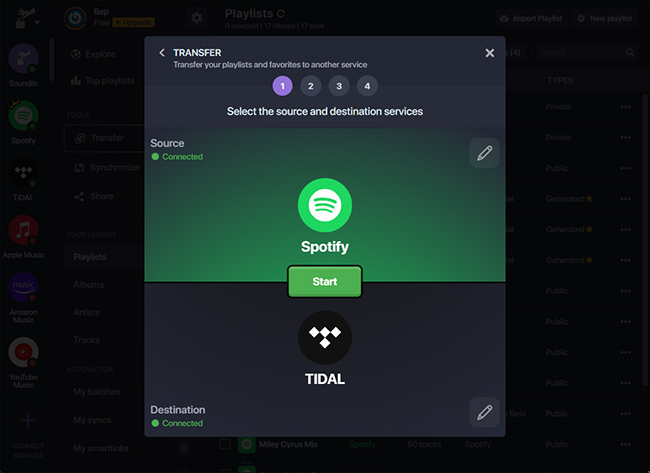
Step 4. Soundiiz will display the playlist summary. Confirm and execute the transfer.
Soundiiz is a powerful online music management tool known for its exceptionally high song-matching accuracy and its ability to handle multi-playlist transfers while perfectly preserving the original track order. While it offers the convenience of being a fully web-based service with no downloads required, its free version imposes significant limitations on playlist conversion features, and users may occasionally encounter matching issues with certain tracks that are exclusive to platforms like Tidal or Spotify.
Method 2: Transfer Spotify Playlists to Tidal on Mobile Using SongShift
For users who prefer managing their music libraries entirely from a mobile device, SongShift provides one of the most convenient ways to move playlists from Spotify to Tidal. Although originally designed for iOS, SongShift has gradually expanded support for additional platforms and now serves as a highly efficient mobile-first migration tool. Unlike web-based services that require you to open a browser and manually connect accounts, SongShift integrates deeply with the device’s OS, offering a more app-centric workflow that feels natural for users already accustomed to managing their playlists on mobile device.
Steps to Transfer Spotify Playlist to Tidal with SongShift
Step 1. The interaction begins by installing the application from the App Store or Google Play. Open the app, tap the "Connected Services" icon (usually a plus or settings icon), select Spotify, and log in to authorize access.
Step 2. Repeat the process for Tidal. Ensure both services show a green checkmark or are listed as "Connected."
Step 3. Initiating a new transfer involves tapping the “+” or “Set Up a Shift” button. Tap "Setup Source" and select Spotify.
Step 4. Select whether you want to transfer an entire Playlist, an Album, or individual Songs. Browse your Spotify library within the app and select the specific playlist you want to move.
Step 5. Tap "Setup Destination" and select Tidal.
Step 6. Tap "I'm Finished" to let the app scan both libraries. SongShift will look for matches on Tidal's servers.
Step 7. Once the scan is done, the status will change to "Ready for Review." > Note: This is the most important step! If a song has a slightly different title or is part of a "Deluxe Edition," SongShift might flag it. Tap into the list to manually confirm or fix any mismatches.
Step 8. Once satisfied, tap "Confirm Matches." SongShift will then build the new playlist directly in your Tidal account.
Bonus: Keep Copies of Your Spotify Playlists Forever
While transferring a Spotify playlist to Tidal ensures your collections remain accessible on your new streaming platform, migration tools only move playlist metadata; they do not grant ownership of the underlying audio files. Once your Spotify subscription expires or certain songs become unavailable due to licensing changes, your access to the original tracks can disappear permanently. This is why many users choose to create a local, DRM-free backup of their Spotify playlists before fully transitioning to Tidal or any other service.
This is where DumpMedia Spotify Music Converter becomes indispensable. Unlike playlist transfer platforms, DumpMedia focuses on extracting and converting the actual audio content from Spotify into standard, DRM-free formats. By loading your playlist into the converter, you can save every track as MP3, M4A, FLAC, or WAV, fully playable offline and compatible with any device or audio software. The process preserves metadata such as artist, title, and album information, making it easy to organize your backup or re-import the files into your preferred player.
Steps to Backup Spotify Playlist
Step 1. Download the installation package for your operating system (Windows or macOS). Open the downloaded file and follow the on-screen instructions to complete the installation. Once installed, launch DumpMedia Spotify Music Converter on your computer.
Good News: Spotify Music Converter has now been integrated into our new software, Any Music Converter. The new software integrates all the previous Spotify music conversion features while expanding support to multiple streaming platforms, offering more output formats, and improved performance.
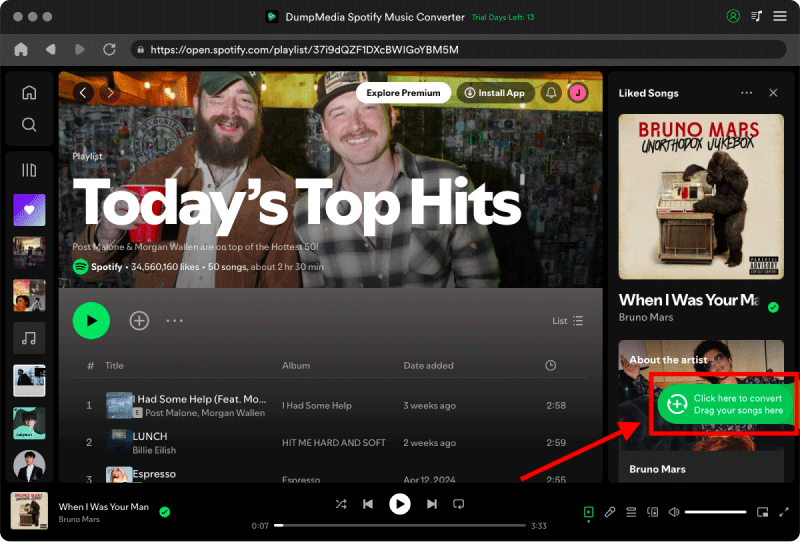
Step 2. Log in using your Spotify account through the built-in player. Browse or search for the content you want to convert. You can add songs, albums, or playlists by clicking the “Add to Convert” button or dragging them into the conversion panel.
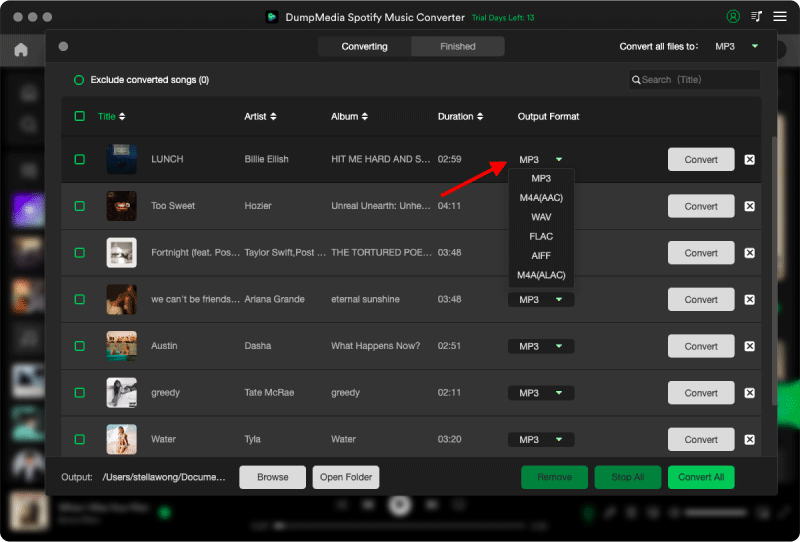
Step 3. Choose your desired output format and quality settings.
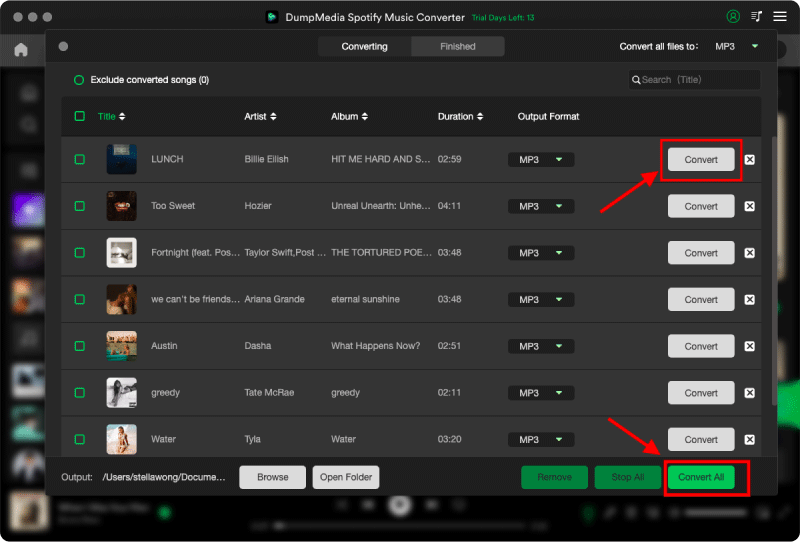
Step 4. Click the “Convert” button to start downloading. Wait for the conversion to complete.
With DumpMedia, you can effectively “future-proof” your Spotify playlists. Even if you later move to Tidal, Apple Music, YouTube Music, or another service entirely, your personal music archive remains intact and unaffected by changes in streaming availability.
FAQs
Q1: Can DumpMedia transfer a Spotify playlist to Tidal directly?
No. DumpMedia downloads and converts Spotify music files, but does not sync playlists to Tidal.
Any Music Converter currently only supports syncing Spotify songs to Apple Music, Amazon Music, etc. DumpMedia does not yet support Tidal.
Q2: Why don't some tracks transfer to Tidal?
Even the best migration tools encounter issues. Common problems include:
- Some Spotify-exclusive releases may not exist on Tidal.
- Metadata mismatches can cause incorrect matches or missing tracks.
- If a song is restricted in your geography, Tidal cannot import it.
- If playlist permissions are limited, transfer tools cannot read them.
Q3: Will playlist transfer tools maintain listening history or likes?
Unfortunately, no. Only playlist metadata transfers.
Q4: Do these tools work with free Spotify accounts?
Some do (e.g., Soundiiz), but track availability may be limited.
Conclusion
Moving your Spotify playlist to Tidal doesn’t need to be difficult. With the rise of cloud-based playlist transfer tools, the process is faster and more accurate than ever. Whether you prefer a fully automated migration or a combination of playlist transfer plus offline music backup, you now have a comprehensive roadmap.
DumpMedia Spotify Music Converter plays a key role in preserving your Spotify library, especially tracks that do not transfer properly to Tidal or may not exist on that platform. If you’re ready to safeguard your music before switching platforms, start by downloading your Spotify library with DumpMedia Spotify Music Converter.